Connecticut is 68% forested; consequently finding a decent view of the countryside is complicated. One can climb all the hills one wants…and not see anything aside from trees. The exceptions come from either manmade clearings (roads, house lots, towers) or from the rare rock outcropping. This is a view from the latter, looking north of east down the Farmington River valley as it winds through New Hartford. Esperanza is off to the right of picture, outside of the frame, on the range of hills that forms the horizon line on that side.
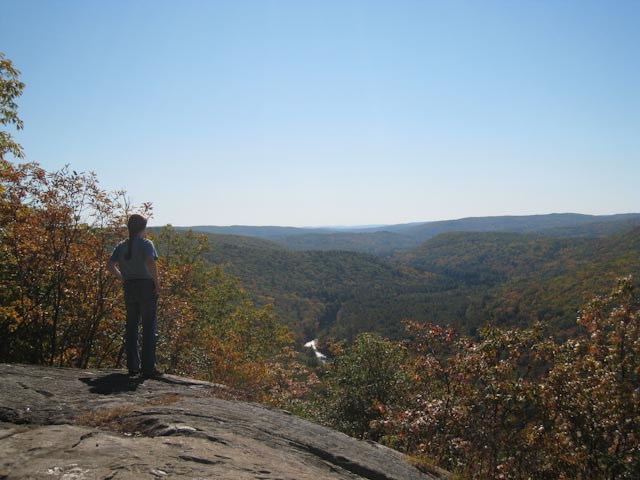
Connecticut will never win any points in the ‘My home is more rugged than yours’ contest*; but this picture does give a good sense of what the landscape is like: not flat, if you are walking across it the constant small up/down, stream/rock/tree is surprisingly time consuming, and despite being the third most densely populated state, comprised almost entirely of small private landowners, astonishingly full of trees. Those trees hide a great many sins of course, as they tend to obscure the amount and spread of development. The picture also points out precisely why rivers are the main highways of early exploration. The Farmington is not a big river, but for a guy with a canoe it would be much faster than the hill/swamp/tree/rock dance.
*One of the more fascinating, and irritating, characteristics of American culture is the macho point-scoring of the contest, ‘because I live in either a) a ‘harsh’ environment or b) city x I am a stronger/better person than those who have not had enlightenment, namely you.’ To be fair, it may be a colonist thing, I have known Canadians, Aussies, and Kiwis to indulge in it as well, but never quite so consistently and arrogantly. Europeans take the tack of ‘I am living in the place where the Enlightenment happened, therefore…’ so perhaps I ought to chalk it up to human nature.


The personal relationship to land, and landscape (not the same relationship at all) is fascinating. There certainly is a tendency to aggrandizement of one’s self on the basis of one’s location for any number of reasons. Another relationship that I find fascinating from personal experience is that which comes from familiarity as opposed to novelty. The tourist-traveler often values a landscape (and rarely the land in any other terms) mostly on the basis of its immediately-perceived beauty or novelty or just strangeness. The person “in place” often perceives and values a landscape on the basis of intimate familiarity, as expressed by your comment locating Esperanza in relation to this particular photograph. A place is perceived as lovely (“loved”?) if for no other reason than that it is intimately known. For most of us, I think, even the most pedestrian of views can achieve that kind of familiar beauty, if we choose to look at them with kindly acceptance. Some of us can also, at various times in our lives, enjoy the beauty of the familiar coupled with more photogenic beauty.
For the future generations – please identify the folks in the photos! We know now, but how will they know then?
Quite! Just like anything familiarity can breed contempt or it can breed appreciation for a landscape. The impressive people are those who can appreciate both the view out their kitchen window and the view of a foreign landscape, both carry substantial emotional baggage. I was actually discussing something along these lines a few days ago when I had dinner with the president of our local land trust. We were discussing the problem of public outreach (their endowment is much too small); I felt, and she agreed, that the only way people would care about the local landscape of the area was if they knew the landscape on an intimate level. Yellow Mountain is actually the example I used; that it has gone from being a piece of woods, very generic, to being a place with a unique and diverse character. Once it went from the generic to the individual, it acquired more character. It is hard to love the generic.